
Alexander Alexeev interviewed by Khim-Kurier magazine
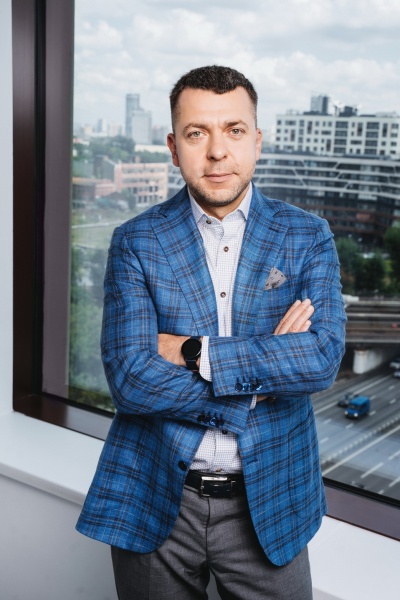
Twenty years ago Alexander Alexeev graduated from the history faculty of Saint Petersburg State University; today he writes history himself, as general director of Infotech-Baltika M, one of the largest players in the Russian tank container market. We met Alexander to talk about the present and the future of this growing business.
Tank containers still account for a relatively small share of the transport market. How far can that share grow in the near future?
The share is growing and will keep growing, although there will be no leap like the one in 2012–2015, when the market shifted to tank containers en masse. I think growth will stay at around 10 per cent a year, and there are two main drivers. The first is the natural replacement of rail tank wagons by containers, simply because specialised wagons are not available. The second is the rising output and export of base petrochemicals.
And what is holding the market back?
Over the past three years the cost of leasing rail flat wagons has risen roughly two and a half times, and that acts as a constraint. Tank container operators have to fight to keep rates and service at the level clients need while still securing flat wagons at a sensible price. It is not an easy balance.
What does a tank container cost today?
The price depends directly on demand and on the price of steel. For the past two or three years both have been broadly stable. As for figures, the T11 — the most common container, with a capacity of 25–26 m³ — costs around 1.4 million roubles excluding VAT, but particular cargoes often require specialised equipment that can cost several times more.
China is the main supplier of containers. Why are Russian tanks not displacing it?
There are currently no conditions in Russia for building tank container production that could compete with the Chinese on the global market, and the Russian market alone is too small for that to work. Unfortunately neither stainless steel, nor valves, nor wages are cheaper here; sometimes they are considerably more expensive than in China.
What is specific about the Russian market?
By various estimates the entire world market is around 600,000 tank containers. Of that, according to Argus, Russia accounts for about 23,000. Our particularity is that we are small and unlike anyone else. Only here and perhaps in China does such a large share of tank container transport run by rail. Russia has built its own, as always unique, model. That is hardly surprising in a country where even the track gauge is different. We have our own path and our own gauge, in every sense.
And your own problems.
The main difficulty is designing schemes that let a tank container turn around faster, avoid standing under loading and discharge, and bring us steady income and the client steady service. That requires complete openness and a full exchange of information, and not every plant with its many departments is capable of it. In the end, when the client is not ready to put all the cards on the table, everyone loses.
There have been cases where, because of a lack of openness and poorly defined tasks, plants could not ship their product, their storage filled up and production risked being halted. And that is before counting what clients lose when a tank container is not filled properly. If a loading rack fills a container to 85 or 89 per cent instead of the 95 per cent it should, we are carrying air, and on the scale of a large contract that is an enormous loss and an obvious saving. Look deeper into how client and operator work together — idle time, including in-plant logistics, loading norms, equipment on the racks, the temperature of loading and discharge — and there are many opportunities to optimise. But that calls for cooperation rather than passing problems back and forth.
How realistic is it for a Russian operator to compete with foreign ones outside Russia?
We are one of two, at best three, Russian companies that have gone beyond the borders of the Russian Federation. Infotech-Baltika M now works on the legs between Russia and Europe, China, South Korea, Türkiye and the Middle East. We send tank containers to South America and even to New Zealand.
We have to compete with foreign companies both globally and in Russia, and I can say honestly that at first it was hard. They sometimes have more experience in international logistics and more forgiving requirements for profitability and payback. Even so, we learned to win and gained invaluable practical experience. Over several years Infotech-Baltika M built a team that specialises in international shipments and does the difficult work of joining the customs of international logistics to Russian reality.
Freight flows always reflect what is happening in a country. What trends do you see in Russia today?
Let us start with the bad and finish with the good. Russia exports a great deal of inexpensive product, and in recent years that flow has only grown, helped by market conditions and by the rouble exchange rate. On one hand this brings foreign currency revenue to everyone in the export chain; on the other it shows that industry still sells raw material abroad, from which global players make more expensive products that we then import.
As for good trends, I would note the gradual increase in processing depth and the appearance of new products and plants. SIBUR has opened a new production site in Perm, and Gazprom Neftekhim Salavat now makes butyl acrylate and glacial acrylic acid that are sold on every continent.
Does it matter to you whether the goods you carry are expensive or cheap?
The more expensive the product, the smaller the share of delivery cost in its final price, and the more room there is to offer the client a high value-added service. Unfortunately, when we carry cheap cargo — sulphuric acid, for instance, which plants simply have to get rid of — there is little prospect of growing revenue.
One of the global processes some call the third technical revolution is machine learning, artificial intelligence and cloud solutions. Has that reached your business?
I regularly attend specialised conferences in Europe and I see that even for the largest global chemical companies these concepts do not yet go beyond impressive presentations and pilot projects. We have working groups inside the company studying the latest developments, but we are only part of a global chain and cannot consider our own solutions in isolation from our clients: their plans and programmes come first for us.
Safety also comes first. Our cargo is often so dangerous that a spill could cause an environmental accident, so we have no right to take risks.
What did the crisis teach you? Did you change the way you work so the company stays stable through another one?
It so happens that we are a financially stable company. We have never borrowed in foreign currency. After the crisis we took steps to increase the share of foreign currency revenue and deliberately took on contracts that may not be highly profitable but generate a large volume of currency. That currently insures us against changes in the value of our key asset, since tank containers are both bought and leased in dollars. So if the dollar were, heaven forbid, to double again, we would come through it.